
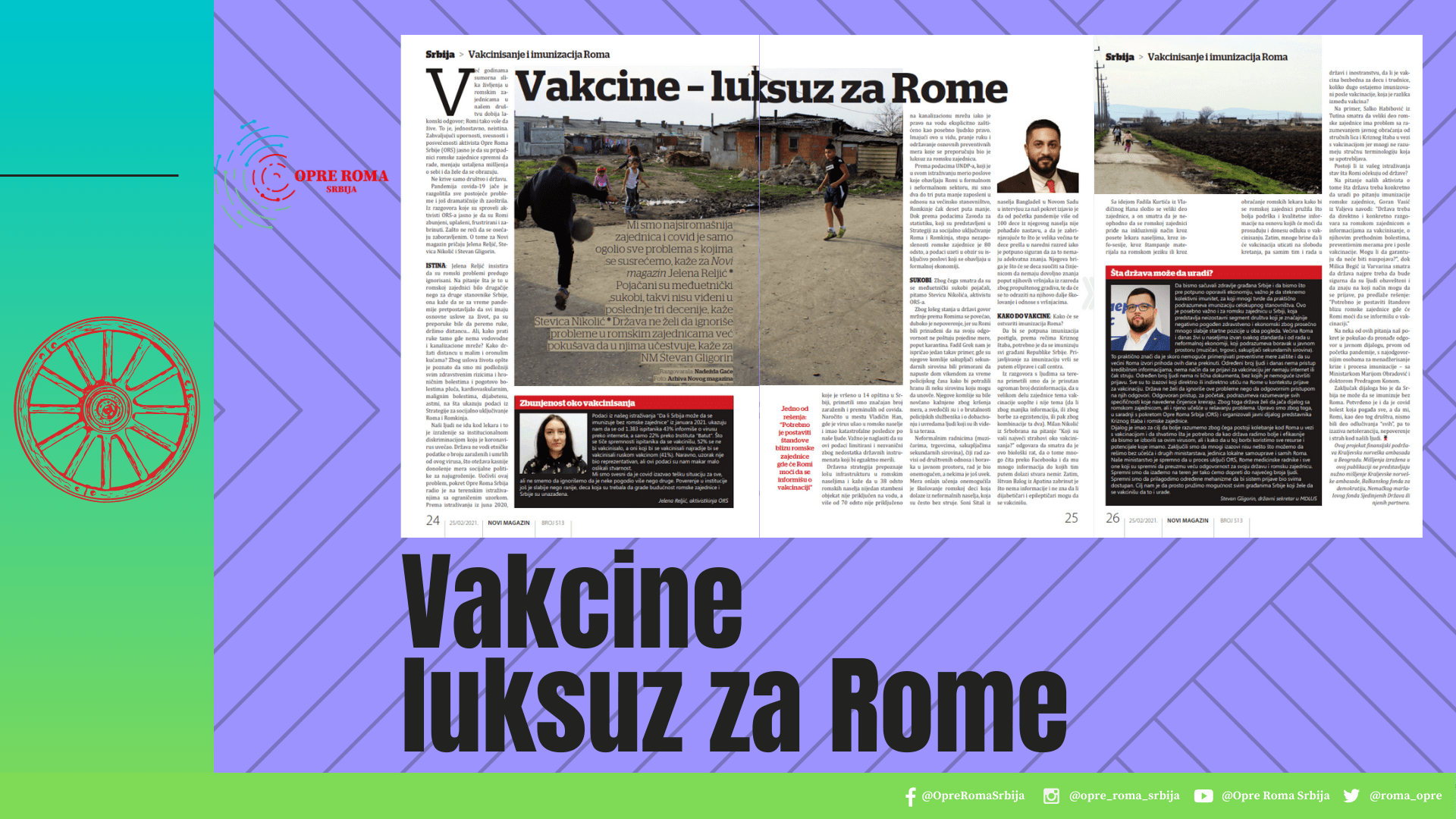
Vaccines luxury for Roma
We are the poorest community and covid just exposed all the problems with which we meet, says for Novi Magazine Jelena Reljić * The interethnic conflicts are reinforced, such has not been seen in the last three decades, says Stevica Nikolic * The state does not want to ignore problems in Roma communities and its already trying to participate in them, tells NM Stevan Gligorin
Interviewed by: Nadežda Gaće Photo: Archive of the New Store
For years, the gloomy picture of Roma living in communities in our society has received a laconic answer; Roma like to live like that. That is simply untrue. Thanks to the persistence, awareness, and commitment of the Opre Roma activists of Serbia (ORS), it is clear that members of the Roma community are ready to work, change established opinions about themselves, and want to be educated. They don't just blame society and the state. The COVID-19 pandemic has exposed all existing problems more strongly and exacerbated them even more dramatically. From the conversations conducted by ORS activists, it is clear that Roma is confused, scared, frustrated, and worried. Why not be said, they feel forgotten. Jelena Reljić, Stevica Nikolić, and Stevan Gligorin talk about that for Novi magazin.
TRUTH: Jelena Reljic insists that Roma's problems have been ignored for too long. When asked what was different in the Roma community than for other residents of Serbia, she said that during the pandemic it was assumed that everyone had basic living conditions, so the recommendations were to wash our hands, keep our distance ... But how to wash your hands where there is no water and sewage network? How to keep distance in small and dilapidated houses? Due to living conditions, it is generally known that we are more susceptible to all health risks and chronic diseases, especially lung diseases, cardiovascular, malignant diseases, diabetes, asthma, as indicated by the data from the Strategy for Social Inclusion of Roma Men and Women.
Our people do not go to the doctor and that is more pronounced with the institutional discrimination that the coronavirus has increased. The state does not keep ethnic data on the number of infected and dead from this virus, which makes it difficult to later adopt social policy measures for the most endangered. Noticing this problem, the Opre Roma Serbia movement worked on field research with a limited sample.
Confusion about vaccination
Data from our survey "Can Serbia be immunized without the Roma community" from January 2021. Indicate that out of 1,383 respondents, 43% are informed about the virus via the Internet and only 22% through the Batut Institute. Regarding the readiness of the respondents to be vaccinated, 52% would not be vaccinated, and those who would be vaccinated would prefer to be vaccinated with the Russian vaccine (41%). Of course, the sample was not representative, but these data gave us at least a little sense of reality. We are aware that the covid caused a difficult situation for everyone, but we must not ignore that he hit some more than others. Confidence in institutions is even weaker than before, children who were supposed to build the future of the Roma community and Serbia are backward.
According to the research from June 2020, which was conducted in 14 municipalities in Serbia, we noticed a significant number of infected and dead people from covid. Especially in Vladicin Han, where the virus entered the Roma settlement and had catastrophic consequences for our people. It is important to emphasize that these data are limited and unofficial due to the lack of government instruments that would measure exactly. The state strategy recognizes bad infrastructure in the Roma settlements and says that in 38 percent of Roma settlements no building is connected to water, and more than 70 percent are not connected to the sewer network although the right to water is explicitly protected as a special human right. With this in mind, washing hands and maintaining the basic preventive measures that were recommended was a luxury for the Roma community. According to the UNDP, which in its research measured the jobs that performed by Roma in formal and the informal sector, we are two to three times less employed than the majority population, Romani women even ten times less. While according to the data of the Bureau of Statistics, which are presented in the Strategy for Social Inclusion Roma men and women, the unemployment rate of the Roma community is 80 percent, and the data taken into account are exclusively jobs performed in the formal economy.
What the state can do?
In order to secure the health of the citizens of Serbia and to fully recover the economy as soon as possible, it is important to acquire collective immunity, which many claims practically implies immunization of the entire population. This is especially important for the Roma community in Serbia, which is an indispensable segment of society that is significantly negatively affected by health and economy due to the average much weaker starting position in both respects. Most Roma still lives in settlements beyond any standard and from working in the informal economy, which means living in a public space (musicians, traders, collectors of secondary raw materials). This practically means that it is almost impossible to apply preventive protection measures and that most Roma has lost their sources of income these days. A certain number of people still do not have access to credible information, there is no way to apply for vaccination because they do not have internet or even electricity. A certain number of people do not even have personal documents, without which it is impossible to register. These are all challenges that directly or indirectly affect Roma in the context of applying for vaccination. The state does not want to ignore these problems, but to respond to them with a responsible approach. A responsible approach, for a start, implies understanding all the specifics that these facts create. Therefore, the state wants to strengthen the dialogue with the Roma community, but also its participation in solving problems. That is why, in cooperation with the Opre Roma Serbia (ORS), we organized a public dialogue between representatives of the Crisis Staff and the Roma community. The dialogue aimed to better understand why there is hesitation among Roma regarding vaccination and to understand what it takes to work better and more efficiently as a country to fight this virus, but also how to use all resources in this fight and the potentials we have. We concluded that many challenges are not something we can solve without the participation of other ministries, local self-government units, and the Roma themselves. Our ministry is ready to include ORS, Roma medical workers, and all those who are ready to take greater responsibility for their country and the Roma community in the process. We are ready to go out on the field because that is how we will reach the largest number of people. We are ready to adjust certain mechanisms so that the application system is accessible to everyone. Our goal is to simply provide an opportunity for all citizens of Serbia who want to be vaccinated to do so.
CONFLICTS: Why does he consider that interethnic conflicts have intensified, we ask Stevica Nikolić, an ORS activist. Due to the poor situation in the country, hate speech against Roma has increased, there is a deep mistrust because the Roma were forced not to respect certain measures on their own responsibility, like quarantine. Fadil Grek told us one such example, where his neighbors, collectors of secondary raw materials, were forced to leave home on weekends during curfew to look for food or some raw material they can to cash. His neighbors were fined for violating the measures, and they also testified about the brutality of police officers and about throwing and insulting people who saw them from the terraces. For informal workers (musicians, traders, collectors of secondary raw materials), whose work depends on social relations and living in public space, the work was disabled, and for some, it is still. The online learning measure made it impossible 1is the schooling of Roma children who come from informal settlements, who are often without electricity. Sony Sitas from neighborhood Bangladesh in Novi Sad in an interview for our movement he stated that since the beginning of the pandemic more than 100 children from his neighborhood did not attend classes, and it is worrying that the vast majority of those children went to the next grade, although is completely sure that they do not have adequate knowledge for that. His concern is that children will face the fact that they do not have enough knowledge like their classmates because of missed material, and that this will affect their further education and relationships with peers.
HOW TO GET THE VACCINE: How will Roma immunization be achieved?
To complete immunization According to the Crisis Staff, it is necessary to immunize all citizens of the Republic of Serbia. Application for immunization is done through eGovernment and call center. From conversations with people from the field, we noticed the presence of a huge amount of misinformation, yes for a large part of the community, the topic of vaccination is not a topic at all (whether due to lack of information, or due to struggles for existence, or because of a combination of the two). Milan Nikolić from Srbobran to the question "What are your biggest fears about vaccination?" responds that he thinks this is a biological war, that he reads a lot about it on Facebook, and that he much of the information obtained in this way creates unrest. Then, Istvan Balog from Apatin is worried because he has no information and does not know if diabetics and epileptics can be vaccinated. A large part of the community agreed with the idea of Fadil Kurtić from Vladičin Han considers it necessary to approach the Roma community in a more inclusive way through visits of doctors to settlements, through info-sessions, through printing materials in the Romani language, or through the treatment of Roma doctors in order to provide the best possible support to the Roma community and quality information on the basis of which they will be able to judge and make a decision on vaccination. However, many worry whether vaccination will affect freedom of movement, and thus working in the country and abroad whether the vaccine is safe for children and pregnant women, how long we stay immunized after vaccination, what is the difference between vaccines? For example, Salko Habibović from Tutina believes that a large part of the Roma community has a problem with understanding public addresses from professionals and the Crisis Staff regarding vaccination because many do not understand the professional terminology that is used. Is there from your research attitude what do Roma expect from the state? When asked by our activists Fr.what the state needs to do specifically in terms of immunization Roma communities, Goran Vasić from Valjevo states: "The state needs to talk directly and specifically Fr. with the Roma community about information for vaccination, about their previous illnesses, about preventive measures before and after vaccinations, can they guarantee that there will be no side effects? ”while Milica Begic from the Barbarian thinks that the state should first make sure that people are informed and know how they can apply and proposes a solution: "It is necessary to set up stands near the Roma community where Roma can be informed about vaccination. ”Our movement has tried to find answers to some of these questions in public dialogue, the first since the beginning of the pandemic, with the most responsible persons for management crisis and immunization process - with Minister Marija Obradović and Dr. Predrag Kon.
The conclusion of the dialogue was that Serbia cannot be immunized without Roma. It has also been confirmed that covid is a disease that affects everyone, but we, the Roma, as a part of that society, were not part of the decision-making of "everyone", so it causes intolerance, mistrust, and fear among our people.
This project is financially supported by the Royal Norwegian Embassy in Belgrade. Opinions expressed in this publication do not represent the necessary opinions of the Royal Norwegian Embassy, Balkan Fund for democracy, the German Marshall Fund of the United States, or her partners.