
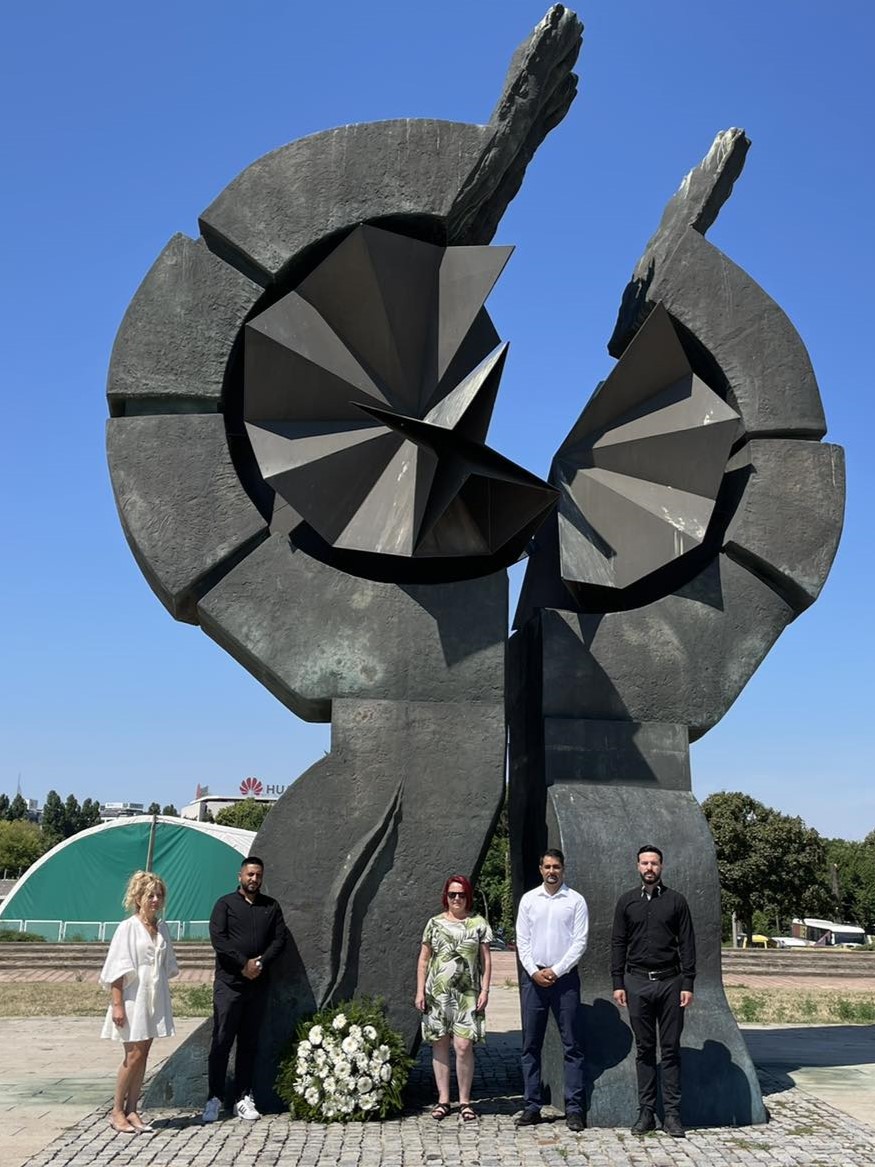
Is the memory of the Roma victims of the Holocaust enough?
Commemorations are necessary so that we can understand the demons of human nature and, as humanity, recognize what we are “capable” of doing, and how “good people” can sometimes contribute to mass murder by giving their support to the group in power.
For us Roma, commemorations are essential in order to remind the wider public of the Holocaust against Roma. The extermination of Roma during the Second World War most often remains outside school curricula and the historiography of the Nazi genocide. However, it is not enough to attend commemorations and deliver public speeches. We Roma must ask ourselves: how can we prevent history from repeating itself?
States use commemorations to show empathy toward the dead, but they forget the living. Since the adoption of the UN Convention on the Prevention and Punishment of the Crime of Genocide in 1948, Roma property, employment, constitutional rights and human rights in European societies have not been respected. For one day of commemoration, states ignore 364 days of humiliation, harassment, violence and killings of Roma across Europe. For every memorial built, there are 1,000 Roma homes destroyed in European countries.
We must establish a connection between historical events and today’s situation: anti-Roma violence is legitimized through democratically elected far-right extremist groups — Jobbik in Hungary, Ataka in Bulgaria, Lega Nord in Italy, Kotleba in Slovakia. Should we accept that countries such as Hungary and Slovakia build their reputations through progressive statements at the international level, while practicing the segregation of Roma children in schools and the forced sterilization of young Roma women in their own countries? Should we accept that the German government organizes dozens of commemorations for the Holocaust while at the same time forcibly sending tens of thousands of Roma to Kosovo, where they will face discrimination and threats without any protection?
These are only a few examples that illustrate how history repeats itself in relation to us, and how remembrance and education about the Holocaust alone have their limits. A study conducted by Germany’s Federal Anti-Discrimination Agency found that, although most Germans know about the Holocaust against Roma, every third person believes that Germany bears no special responsibility for the extermination of Roma by the Nazis and their allies during the Second World War.
What must be done?
We must face the brutal fact that our memory is being used against us. We should not be part of that game. Recognition of the Holocaust against Roma must be linked to substantive progress for Roma. We cannot prevent states from using our memory for their own purposes, but we can demonstrate the collective capacity to transform that memory into real and substantive change for our community.
We should help public institutions re-examine their concepts of progress and assess how far they have come since the adoption of the Convention on the Prevention and Punishment of the Crime of Genocide. We must question the dual commitment to democratic ideals, undemocratic practices, and perverse aspirations to develop politically and economically inclusive institutions. At the same time, we must examine what kind of progress is achieved through recognizing the Holocaust against Roma, including in Serbia.
A few years ago, for example, the European Parliament adopted a resolution calling for the recognition of August 2 as the International Day of Remembrance of the Roma Holocaust. This is something we must do for the European public and for Roma, who deserve to know their own history in order to better understand the present and create a better future.
The narrative about the Holocaust against Roma must change: we are still alive to bear witness because we showed resilience and resistance before, during and after the Holocaust. These facts are largely ignored in traditional historiography, where Roma are presented only as victims. For example, few people know about May 16, 1944, when Roma in Auschwitz rose up and resisted the Nazis.
After centuries of oppression, violence, slavery and mass extermination, we are still the most resilient and politically creative minority in Europe. In order to succeed together, especially because we were not independent citizens of our own sovereign state, we must fight uncompromisingly for our independent and sovereign “state of mind.”
We must think of ourselves as a distinct and powerful culture, rather than as a temporary, inferior subculture dependent on others. We must accept and strengthen our uniqueness, our proud past, and our right to develop an independent system of beliefs that addresses our specific interests.
The memory of the Holocaust should be present in our minds at every moment. It should shape how we see ourselves in society; who or what our enemy is; who our friends are with whom we are ready to build coalitions; how we vote; and how we lead our economy in the future.
If we do not use memory to strengthen our position and influence, we will once again become prey to opportunistic and irresponsible politicians who abuse our memory to raise their political profile internationally, while leaving our people at home exposed to humiliation and violence by the majority.
Mensur Haliti
Director for Roma Democracy and Governance
Roma Initiatives Office, Open Society Foundations