
Summarizing employment data
Summary:
The aim of this research is to obtain relevant data that indicate that Roma wants to work, based on data obtained online, through the method of surveys in the form of google forms with the Roma community in Serbia. With a sample of 436 respondents, we came to the conclusion that Roma from Serbia wants to work and that they are therefore ready to change their professions, to attend various courses and training that are currently current in order to get their jobs. A small percentage of Roma who is employed are often employed as seasonal workers, have temporary-occasional contracts, or work part-time. According to our survey conducted in November 2020, only 20% of respondents are employed while the other 91% are still waiting for their jobs.
INTRODUCTION :
According to the latest census, the Roma is the second largest national minority with a 2.05% share of the total population. This means that at least 150,000 able-bodied Roma live in Serbia (unofficially up to 500,000). Of the 150,000 able-bodied Roma living in Serbia, about 120,000 (80%) are unemployed. Out of the total number of Roma, only 27.2% are economically active, and 58.2% of the able-bodied are economically active [1]. According to the latest data of the Ombudsman in Serbia, out of all registered Roma in the employment agency, 25,748 [2] more than (14%) [3] Roma men and women are not trained to use the self-employment programs available in which they have tried, while only 76 Roma had a chance to participate in public works in 2019. [4] The same report states that out of all registered, only 12.43% of cases were offered jobs to Roma, while the vast majority of 68.36% have been waiting for years for a job opportunity. [5] INTRODUCTION:
According to the latest census, the Roma is the second largest national minority with a 2.05% share of the total population. This means that at least 150,000 able-bodied Roma live in Serbia (unofficially up to 500,000). Of the 150,000 able-bodied Roma living in Serbia, about 120,000 (80%) are unemployed. Out of the total number of Roma, only 27.2% are economically active, and 58.2% of the able-bodied are economically active [1]. According to the latest data of the Ombudsman in Serbia, out of all registered Roma in the employment agency, 25,748 [2] more than (14%) [3] Roma men and women are not trained to use the self-employment programs available in which they have tried, while only 76 Roma had a chance to participate in public works in 2019. [4] The same report states that out of all registered, only 12.43% of cases were offered jobs to Roma, while the vast majority of 68.36% have been waiting for years for a job opportunity. [5]
METHODOLOGY
Research goal and hypothesis
The aim of this research was: first to determine the level of education of the respondents, second whether they are employed and if not whether they want to work, third whether they are ready to go to some training and courses that are currently current and whether they would be ready to change their profession for the sake of work, fourth to what extent the Roma community wants to work. What we expect during this research is the interest of Roma to work and have a contract for an indefinite period of time, considering that the jobs they work for most often are seasonal, temporary, and occasional jobs in which they cannot provide their families and themselves with adequate living conditions.
Sample and procedure:
The survey conducted by the ORS in November 2020 included 436 respondents from our target group (Roma men and women). The data we obtained is through two online surveys in the form of a "google questionnaire". One survey related to Roma employment, their classifications, and employment while the other related to Roma readiness to work. The survey was online and referred to the Roma community throughout Serbia.
Instruments:
The research was conducted through an online survey in the form of a "google questionnaire. The task of the respondents was to answer the questions contained in the surveys. What we obtained from the research through the survey method are the answers of 436 respondents from Roma communities throughout Serbia, which are considered relevant because they include different age limits of respondents, professional profession, and location.
THE RESULTS
 |
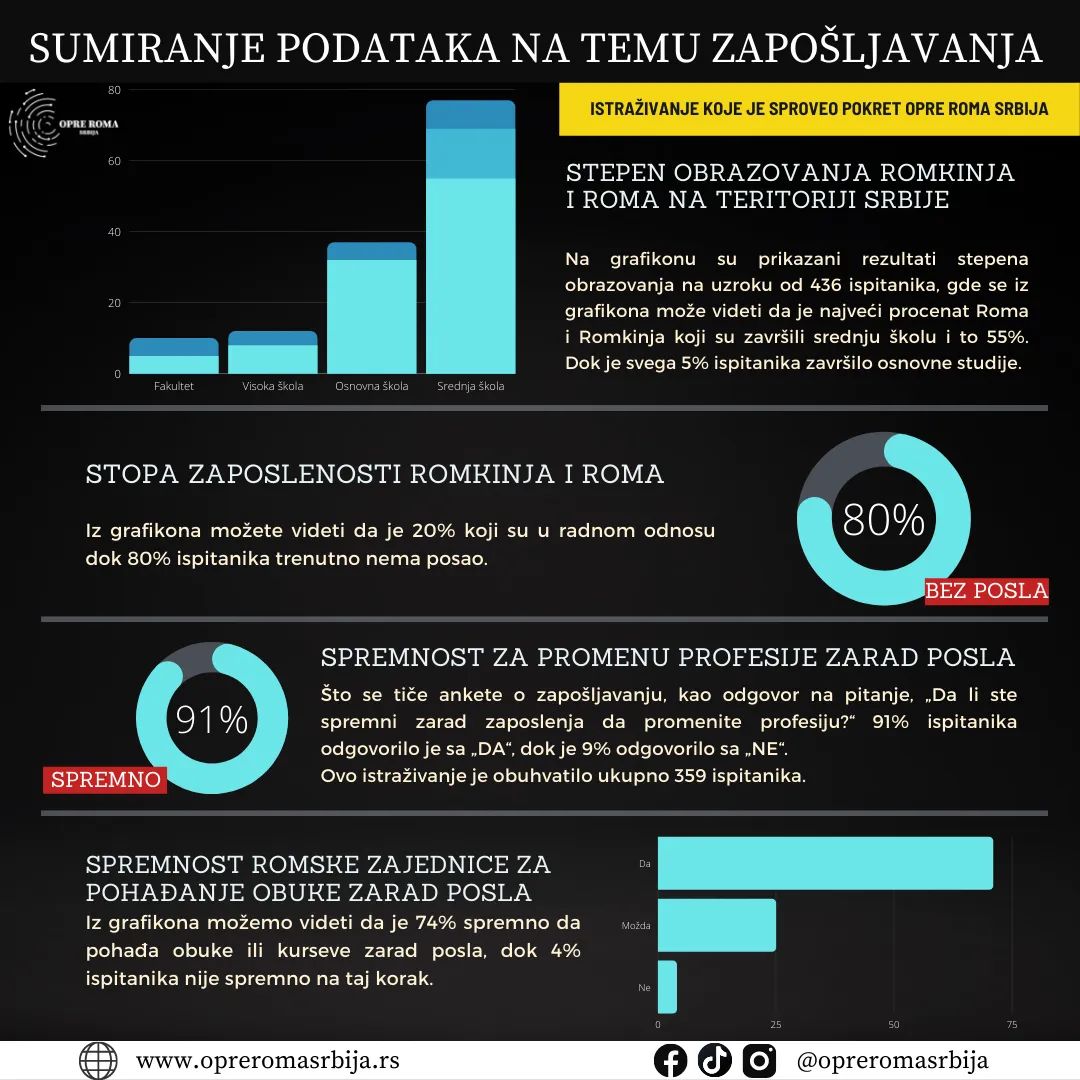
Graph 1.1 Level of education of Roma men and women on the territory of Serbia
Graph 1.1 shows the results of the level of education of 436 respondents, where the graph shows that the largest percentage of Roma men and women who have completed high school is 55%. While only 5% of respondents completed basic studies.

Graph 1.2 Employment rate of Roma men and women
From Graph 1.2 you can see that 20% are employed while 80% of respondents currently do not have a job.

Graph 1.3 Willingness to change the profession for the sake of work
Regarding the employment survey, in response to the question, "Are you ready to change your profession for the sake of employment?" As you can see from Graph 1.3, 91% of respondents answered "YES", while 9% answered with "NOT". This study included a total of 359 respondents.

Graph 1.4 Readiness of the Roma community to attend training for work
From Graph 1.4 we can see that 74% are ready to attend training or courses for work, while 4% of respondents are not ready for that step.
CONCLUSION AND IMPLICATIONS
The research, as could be expected, showed that a large number of Roma do not have a job on the territory of Serbia. It turned out that 80% of respondents do not have their own jobs and are waiting for a job, while only 20% are employed. Also, the research showed that Roma wants to work and is ready to even attend training and courses that are current in order to get a job. Based on the above data, we conclude that 91% of respondents from Roma communities are willing to change their professions to work, which actually shows a desire for a job. Education outcomes do not appear to have a major impact on improving the employment status of Roma in Serbia. The Roma unemployment rate remains high at all levels of education such as completion of primary school, trade or secondary school, and even primary studies. Through unemployment, the Roma community is pushed into economic exclusion, which has great consequences for society and the state. In addition to all the above, no country, not even Serbia, is interested in its citizens, regardless of nationality, being as poor and economically dependent as the Roma community in Serbia, for several reasons, the most significant of which are social and health care costs. they want to work but there is no possibility for a permanent job, for that reason, there is a high unemployment rate of Roma in Serbia.
[1] http://demo.paragraf.rs/demo/combined/Old/t/t2009_04/t04_0316.htm
[2] ttps://www.redi-ngo.eu/wp-content/uploads/2019/10/0353-443X1608414Z.pdf
[3] http://www.undp.org/content/dam/serbia/Publications%20and%20reports/Serbian/UNDP_SRB_Pod_rizikom_-_Socijalna_ugrozenost_Roma,_izbeglica_i_interno_raseljenih_lica_u_Srbiji.pdf
[4] https://www.ombudsman.rs/attachments/article/6380/Poseban%20izve%C5%A1taj.pdf
[5] Analysis of the UNDP/World Bank/EC Regional Roma Survey 2011.