
The situation in the Roma community as a consequence of the covid crisis
Summary
In order to examine the impact of the covid crisis on the Roma community, as well as to monitor the recovery of the Roma community from the covid crisis this research aims to define the initial, zero state in relation to which the recovery from the crisis will be measured. The research includes twenty locations for which several indicators have been defined, whose analysis defines the level of recovery (availability of water and electricity, employment, number of patients, number of deaths, etc.).
Until the end of the pandemic, such research will be conducted once a month in these locations, and the results, after comparison with the results of previous research, will provide insight into the degree of recovery of the community.
Introduction
The covid-19 virus pandemic, which hit the whole world a year ago, has left a mark on Serbian society. As a consequence of adapting to the current crisis, there has been a drastic change in people's habits and economy, as well as in their way of life. As always, this situation was most felt by the poorest, people without a steady income and without basic resources for life.
A survey conducted in June 2020 by ORS grassroots structures that included 14 municipalities found that 240 members of the Roma ethnic group were infected with the virus while 35 were fatal. The research also states that the reason for that is the lack of water and sewage network, masks, and hygienic means for protection against the pandemic.
The aim of this research is to define the current situations in selected communities as a standard by which the following results will be compared and on the basis of which the results on the degree of recovery of the Roma community from crises will be obtained.
Methodology
The research was conducted using a questionnaire, in the form of a "google questionnaire". Questions can be seen at the following link:
Praćenjesituacije u romskimzajednicama, oporavak od covidkrize - Google Forms
The research, which is the first in a series to monitor the situation in Roma settlements as a result of the Covid-19 pandemic, covered 20 locations. The locations covered by the research are: Aleksinac, Bač, Babušnica, Bela Crkva, Beočin, Bogatić, Bor, Niš, Pirot, Prokuplje, Požarevac, Smederevo, Subotica, Zaječar, Odžaci, Valjevo, Vlasotince, Vladičin Han, i Kovačica.
In these locations, the research will be conducted once a month until the end of the Covid-19 pandemic, with the aim of monitoring the situation in Roma settlements and possibly creating responses to crisis situations as a result of the Covid crisis.
The basic criteria for monitoring the situation were:
- Access to water and electricity
- Employment
- Number of patients
- Number of deaths
- Number of vaccinated
- Support measures
Results and discussion
Access to electricity and water, as well as employment, have been defined as basic indicators for monitoring the condition of the Roma community as a consequence of the humanitarian crisis.
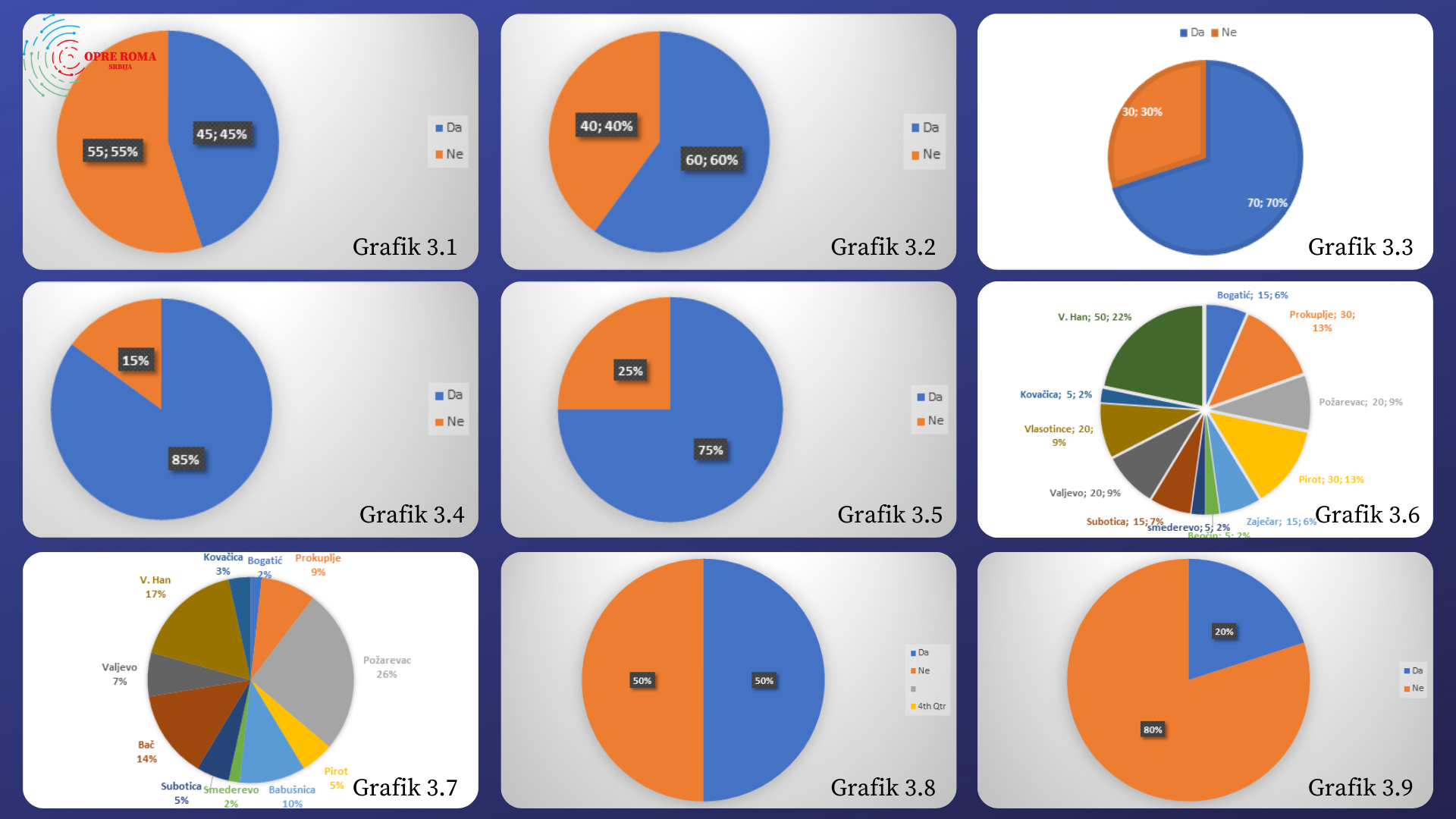
The research showed that a large number of Roma families do not have electricity and water (Graphics 3.1.)

Graphics 3.1. Access to electricity and water in Roma communities
As can be seen from Graph 3.1. 55% of respondents do not have access to electricity and water, which is a devastating result even without the presence of a covid crisis, which makes this problem far more alarming. The research showed that in each of the locations, at least on average, about twenty families do not have access to electricity and/or water.
Also, the research aimed to examine the extent to which the Roma community lost access to electricity and water as a result of the covid crisis (Graph 3.2)

Graph 3.2. Loss of access to electricity and water as a result of the covid crisis
From diagram 3.2. it can be seen that 60% of families previously had access to water and electricity, while currently, only 55% of families have access to these resources, from which it can be concluded that in 5% of families surveyed, there was a loss of access to water and electricity as a result of the covid crisis.
In addition to access to structure and water, one of the indicators of the situation in a society or community is certainly employment, the possibility of providing a livelihood. This research showed that in one of the twenty locations there are no employed Roma, while two locations do not have data. In the remaining eighteen locations, Roma employment is extremely low and jobs are low paid.
The problem of Roma unemployment, as a perennial problem, escalated during the pandemic, when large numbers of Roma lost their jobs. In graph 3.3. the percentage of the location where the job was lost as a result of the crisis.

Graph 3.3. Job loss in Roma communities as a result of covid crises
From the beginning of the pandemic to the end of this research, job losses occurred in 70% of locations, while Roma managed to keep their jobs in only 30% of locations. The research shows that the most affected measures in the fight against covid-19 were primarily musicians, collectors of secondary raw materials, and traders, but there is also a significant number of seasonal workers, workers in amusement parks. It was noted that in one location, the catering facility was closed due to unsustainability due to the covid crisis.
Respondents, as the research showed, believe that some kind of support to the Roma community is necessary for successful overcoming of crisis crises (Graph 3.4.).

Graph 3.4. Is some kind of support needed for the Roma community in overcoming the covid crisis
Over 70% of respondents believe that the most adequate type of support should come from a state institution in the form of support for musicians, collectors of secondary raw materials, and traders as occupations that currently cannot do their job and thus cannot provide a minimum subsistence. Also, a large number of respondents (over 50%) mentioned humanitarian, hygienic, and food packages, as well as financial support as adequate support. Among the adequate support measures was the cleaning of Roma settlements.

Graph 3.5. Institutional assistance to the Roma community
It can be seen from the graphs 3.5. that in 75% of cases the state institutions in some way provided support to the Roma community in overcoming the covid crisis. Support was most often reflected in humanitarian and hygiene packages, as well as financial assistance of 100 euros received by all adult citizens of Serbia...
The number of infected people at the examined locations is shown in Graph 3.6.

Graph 3.6. The approximate number of infected Roma in the examined locations
The graph shows that there is no data for seven locations, while there are infected locations in the remaining thirteen locations. The most critical locations are in Vladicin Han, where according to the results of the examination about 22% of the total patients in the examined locations, then Prokuplje and Pirot with thirty earned (13%), Valjevo with twenty (9%), Subotica and Zajecar with fifteen infected (6%), while at the remaining location the number of infected is less than 10.
The number of deceased Roma in the examined locations is shown in Graph 3.7

Graph 3.7. Number of Roma deaths from coronavirus
In eleven of the twenty locations examined, there were deaths due to the coronavirus. The highest number of deaths was in Pozarevac (26%) and Vladicin Han (17%), followed by Bac (14%) and Babusnica (10%). In other places, the mortality rate was below 10% in relation to the total number of deaths in the examined locations.
In graph 3.8. progress in vaccinating the Roma community was presented.

Graph 3.8. Vaccination of Roma in the examined locations
The diagram shows that the percentage of vaccinated and non-vaccinated is equal, 50%. The most commonly cited reasons for non-vaccination are distrust in institutions, insufficient information, fear, and others.
Graph 3.9. shows the extent to which there was discrimination by the institution when Roma went for vaccination.

Graph 3.9. Discrimination in the immunization process
The diagram shows that 80% of respondents have the perception that they have experienced some kind of discrimination when going to the vaccine, which should certainly be considered as a reason for the poor response of Roma when it comes to vaccination.
Conclusion
The research, as could be expected, showed a really difficult position of the Roma community and an absolute unwillingness to fight the covid-19 virus. It turned out that over 50% of Roma do not have access to electricity and water. Despite such difficult living conditions, thanks to the pandemic, slightly more than 70% of Roma lost their jobs, and thus the only source of income and the opportunity to feed their families. All this has led to the fact that as many as 85% of respondents believe that this crisis cannot be overcome without institutional measures to support the Roma community, primarily musicians, collectors of secondary raw materials, and traders who are currently unable to provide basic funds for their work. Also, the research showed that in each of the examined locations there are infected people, while in more than 50% of the examined locations there are dead people.